
The Xi Jinping Military Purge has reached a critical inflection point in January 2026, fundamentally reshaping China’s military command structure through systematic elimination of senior generals. What began as a corruption investigation in 2022 has evolved into the most comprehensive restructuring of the People’s Liberation Army (PLA) leadership since the Communist Party’s consolidation of power.
The cascade of military purges targeting China’s highest-ranking officers represents more than routine anti-corruption enforcement. This systematic dismantling of rival factions within the Central Military Commission (CMC) signals a strategic realignment of military power ahead of potential geopolitical confrontations, particularly concerning Taiwan.
The Intelligence Leak That Triggered the Xi Jinping Military Purge
The genesis of this unprecedented Xi Jinping Military Purge traces to October 2022, when the U.S. China Aerospace Studies Institute (CASI) published a 242-page classified report exposing China’s Rocket Force. The document contained highly sensitive intelligence: organizational structures, commanding officers’ personal information, missile base locations, and deployed missile specifications—information impossible to obtain through satellite imagery and accessible only to officers with top-level security clearance.
The intelligence breach forced the Chinese Communist Party into immediate internal investigation. Over ten senior Rocket Force generals, including the commander and political commissar, were arrested. The Rocket Force deputy commander committed suicide during the investigation, revealing the severity of the crisis.
Internal investigations revealed the source: the Rocket Force commander’s son, studying in the United States, sold classified internal reports to American intelligence agencies to finance his drug addiction. This breach represented not merely a security failure but a profound vulnerability in China’s nuclear deterrent command structure.


The Factional War: Fujian Clique vs. Shaanxi Network
Xi Jinping had strategically positioned loyalists throughout military command, though their numbers remained limited. He Weidong, Vice Chairman of the Central Military Commission, represented Xi’s highest-ranking military ally—the number three figure in the PLA hierarchy, directly below Xi and Vice Chairman Zhang Youxia, managing China’s two-million-strong armed forces.
He Weidong was removed on corruption charges, including unexplained real estate acquisitions and extramarital affairs with secretaries and subordinates. But He Weidong was merely the beginning.
Following the March 2025 conclusion of the Two Sessions (Lianghui), multiple high-ranking military figures vanished from official rosters: the Rocket Force commander, Eastern Theater Command commander, and Southern Theater Command commander. All shared a common denominator: membership in the “Fujian Clique”—officers connected to Fujian Province, where Xi served as deputy party secretary and governor.
China’s military leadership had operated as a delicate balance between two factions: the Fujian Clique loyal to Xi through He Weidong, and the Shaanxi Network led by Zhang Youxia. As Fujian Clique members were systematically eliminated, only the Defense Minister remained from Xi’s original appointments. Military power concentrated in Zhang Youxia, the number two military official.
Rumors circulated that Xi wasn’t purging his own faction—rather, the Shaanxi Network was reverse-purging the Fujian Clique by weaponizing corruption charges.
The Central Military Commission: A Game of Political Chess
The Central Military Commission represents China’s supreme military authority, embodying Mao’s principle that “political power grows out of the barrel of a gun.” Xi Jinping chairs this seven-member body, which makes military decisions by majority vote:
Original CMC Composition (by rank):
- Xi Jinping (Chairman)
- Zhang Youxia (Vice Chairman) – Shaanxi faction
- He Weidong (Vice Chairman) – Fujian faction
- Li Shangfu – Fujian faction
- Miao Hua – Fujian faction
- Zhang Shengmin – Shaanxi faction (ambiguous)
- Liu Zhenli – Shaanxi faction
Xi’s three appointees (ranks 3-5) were all purged. With three members eliminated but no replacements appointed, the CMC operated with only four members instead of seven, creating a precarious power balance: Xi Jinping (1 vote) versus Zhang Youxia’s faction (3 votes).
The arithmetic seemed to favor Zhang Youxia, but Xi’s chairmanship created deadlock. Zhang could block Xi’s personnel appointments through majority vote; Xi could veto Zhang’s preferred candidates through executive authority.
October 2025: The Mass Purge Announcement
On October 17, 2025, the delicate equilibrium shattered. China’s Ministry of National Defense announced the expulsion of nine senior military officers on corruption charges, including Vice Chairman He Weidong and CMC member Miao Hua.
Beyond He Weidong and Miao Hua, the purge targeted: the CMC Standing Deputy Director, Joint Operations Command Center Standing Deputy Director, Eastern Theater Commander, Army Political Commissar, and Navy Political Commissar. Three were Xi’s direct appointees; the remainder were classified as Xi-aligned officers.
The Fourth Plenum’s hidden focal point was whether the three vacant CMC seats would be filled, and if so, by which faction. The outcome was telling: the three seats remained vacant. The only change was Zhang Shengmin’s promotion to Vice Chairman—an ambiguous figure from the Shaanxi faction but also Xi’s hometown neighbor, potentially loyal to either side.
January 2026: The Final Blow to the Shaanxi Network
Until late 2025, Zhang Youxia appeared resilient. Then on January 24, 2026, China’s state broadcaster CCTV made a bombshell announcement: “The Ministry of National Defense has placed Zhang Youxia and Liu Zhenli under investigation for serious disciplinary violations and illegal conduct.”
With Zhang Youxia and Liu Zhenli’s purge, Xi Jinping successfully completed the military leadership overhaul. Among the original seven CMC members, only Zhang Shengmin survived.
Zhang Shengmin: The Sole Survivor’s Meteoric Rise
Zhang Shengmin’s trajectory reveals the mechanics of the Xi Jinping Military Purge. He served eleven years in the Rocket Force, rotating through critical positions while his peers were systematically eliminated. His promotion velocity was extraordinary:
- Artillery Political Work Department Director: 11 months
- Training Management Department Political Commissar: 8 months
- Support Department Political Commissar: 7 months
- Military Discipline Inspection Commission Secretary: immediate promotion
After ascending to Military Discipline Secretary, Zhang reached CMC membership—the “flower among flowers” of military positions—in just nine months.
Chinese military circles whispered of “Fan Ge Yi Ji” (反戈一擊)—”turning the spear against one’s own forces.” The implication: Zhang Shengmin facilitated the Rocket Force generals’ purge, clearing his path to power.
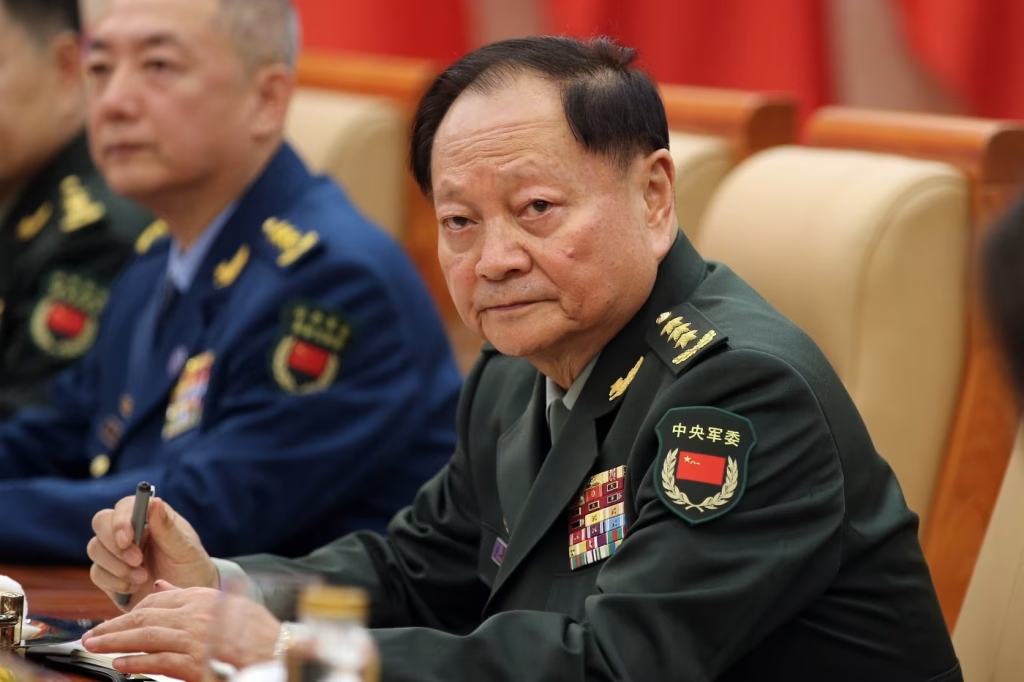
Today, having outlasted even Zhang Youxia, Zhang Shengmin stands as the military’s number two, directly below Xi Jinping. Significantly, Zhang hails from Wugong County in Shaanxi Province, neighboring Xi’s hometown of Fuping County—fellow provincials from adjacent districts.
Historical Precedent: Purges Before Major Military Operations
The comprehensive nature of the Xi Jinping Military Purge aligns with historical patterns preceding major military campaigns. Authoritarian regimes frequently retire aging generals and promote younger officers before initiating large-scale military operations, ensuring command loyalty and operational vigor.
In January 2026 geopolitical context, this pattern carries profound implications for Taiwan. The systematic replacement of experienced senior commanders with younger, presumably more loyal officers suggests preparation for potential military action rather than routine personnel management.
Taiwan’s defense establishment must interpret these developments with heightened concern. The purge’s completion removes potential dissenting voices within the PLA command structure, consolidating decision-making authority in Xi Jinping’s hands. Historical analysis indicates such centralization often precedes, rather than follows, major military undertakings.
Implications for U.S. Investors and Geopolitical Risk Assessment
The Xi Jinping Military Purge carries direct implications for equity markets and geopolitical risk modeling:
Defense Sector Positioning: U.S. defense contractors with Taiwan-focused capabilities—Lockheed Martin (F-16V upgrades), Raytheon (missile defense systems), and General Dynamics (submarine technology)—face elevated demand scenarios as regional tensions intensify.
Semiconductor Supply Chain Vulnerability: Taiwan Semiconductor Manufacturing Company (TSMC) represents a critical node in global chip supply chains, particularly for Apple, NVIDIA, and AMD. Military escalation scenarios necessitate reassessment of concentration risk in Taiwan-based semiconductor exposure.
Regional Ally Defense Spending: Japan, South Korea, and Australia will likely accelerate defense modernization programs, benefiting U.S. and allied defense contractors while straining fiscal budgets.
Chinese ADR De-risking: American Depositary Receipts of Chinese companies face compounded regulatory and geopolitical risk as military tensions escalate. The purge signals Xi’s willingness to subordinate economic considerations to strategic military objectives.
Conclusion: The Xi Jinping Military Purge Completes PLA Restructuring
The Xi Jinping Military Purge has fundamentally transformed China’s military command structure, eliminating factional competitors and concentrating unprecedented authority in Xi’s hands. From the 2022 intelligence leak through January 2026’s final eliminations, this systematic campaign removed both the Fujian Clique that Xi initially installed and the Shaanxi Network that appeared to challenge his authority.
Zhang Shengmin’s survival and promotion—a fellow Shaanxi native who demonstrated loyalty through facilitating earlier purges—establishes the template for military advancement under Xi: provincial connections matter less than demonstrated willingness to eliminate rivals on command.
For investors and analysts, the Xi Jinping Military Purge represents more than internal Chinese politics. It signals preparation for potential military operations, with Taiwan the most probable target. The historical pattern of pre-war military restructuring, combined with the purge’s unprecedented scope, demands serious consideration of elevated geopolitical risk scenarios in 2026 and beyond.
TMM’s Perspective
The completion of Xi’s military purge fundamentally alters my risk assessment for Taiwan-related scenarios. I’m reducing direct exposure to Taiwan-based semiconductor manufacturers not through outright sales, but through strategic options hedging—purchasing out-of-the-money puts on TSMC ADRs with 6-12 month expirations. Simultaneously, I’m building positions in U.S.-based chip fabrication (Intel’s Arizona facilities) and allied semiconductor production (Samsung) as supply chain diversification plays.
The defense sector positioning isn’t straightforward buy-the-headline territory—these stocks have already priced in elevated tensions. I’m more interested in second-order effects: logistics companies with Pacific theater exposure (undersea cable installation, military transport), satellite communication providers facing increased Asian demand, and cybersecurity firms specializing in critical infrastructure protection.
Most importantly, the purge’s completion timeline creates a specific risk window. Historical patterns suggest 12-24 months between military restructuring completion and operational deployment. This places maximum risk concentration in late 2026 through early 2027—a timeline that should inform portfolio construction and hedging strategies throughout 2026.