
The Weak Dollar Bull Market is rapidly taking shape as geopolitical uncertainties resolve and global economic policies align. Despite a flurry of headline risks—ranging from tensions in Iran and Venezuela to domestic disputes in Minnesota—the U.S. equity market continues to demonstrate remarkable resilience. This article analyzes how a coordinated effort to weaken the dollar, reminiscent of a modern “Plaza Accord,” combined with attractive tech valuations, is setting the stage for a significant upward revaluation in asset prices.
Catalysts for a Weak Dollar Bull Market in 2026
The current market resilience is not accidental; it is a structural byproduct of evolving U.S. trade policy and global monetary coordination. The recent resolution of the USMCA renegotiation, where Canada effectively capitulated to U.S. terms (“TACO’d”), signals that the Trump administration is successfully leveraging uncertainty to secure favorable trade deals without crashing the markets before the midterms.
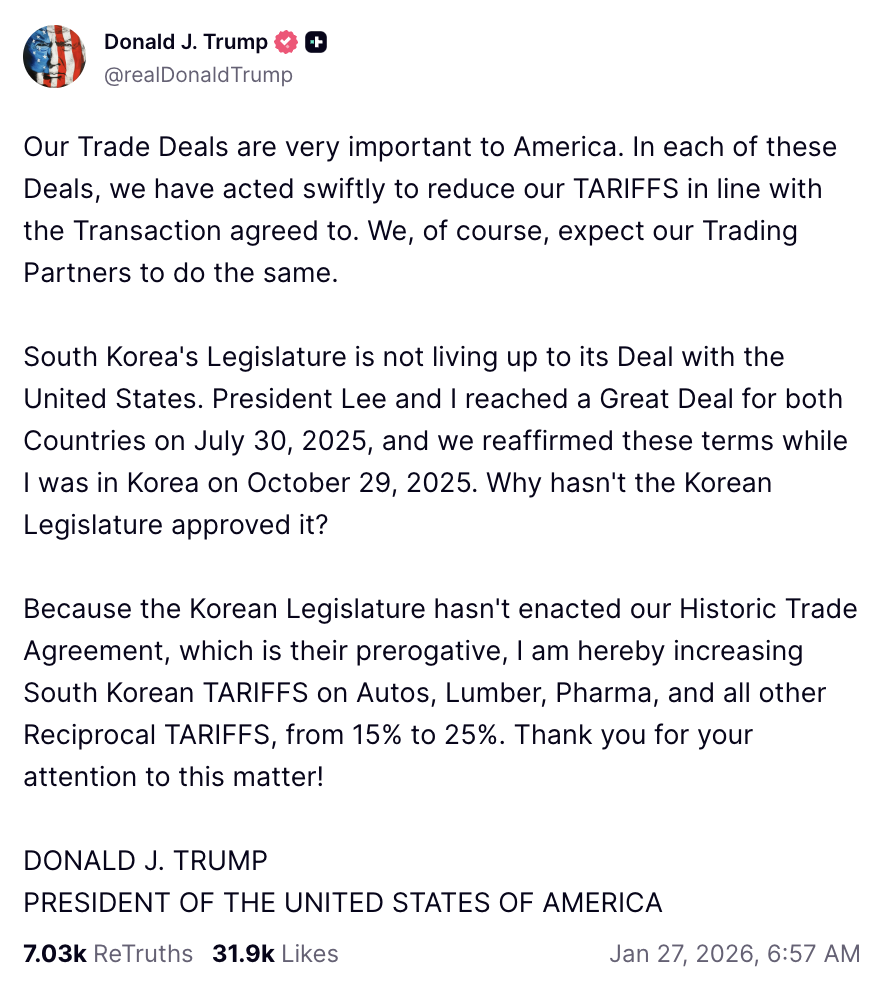
A critical development is the emerging “New Plaza Accord.” Treasury Secretary Bessent is actively coordinating with Japan, South Korea, and Taiwan to manage exchange rates. The objective is clear: a managed depreciation of the U.S. dollar against the Yen, Won, and Taiwan Dollar. President Trump has historically favored a weaker dollar to stimulate domestic manufacturing and boost exports.
This macroeconomic backdrop creates a potent environment for equities. History suggests that when the U.S. economy expands (as evidenced by rising small caps) concurrent with a transition to a weaker dollar, capital flows aggressively into growth stocks. This pattern was observed during the early stages of the post-COVID recovery and in 2017.
Key Mechanism:
- Currency Coordination: Japan and Korea are signaling readiness to intervene against currency weakness, aligning with the U.S. desire for a softer dollar.
- Investment Unlock: South Korea has indicated that $350 billion in promised U.S. investment is contingent on exchange rate stability. By stabilizing the FX market (weakening the dollar), the U.S. unlocks massive inbound capital flows.
Mega-Cap Valuations and Economic Resilience
Beyond the currency narrative, the fundamental case for a Weak Dollar Bull Market is supported by compelling valuation metrics. Despite the prevailing sentiment of fear in sectors like quantum computing and rare earths, the broader technology sector remains attractively priced relative to its growth potential.
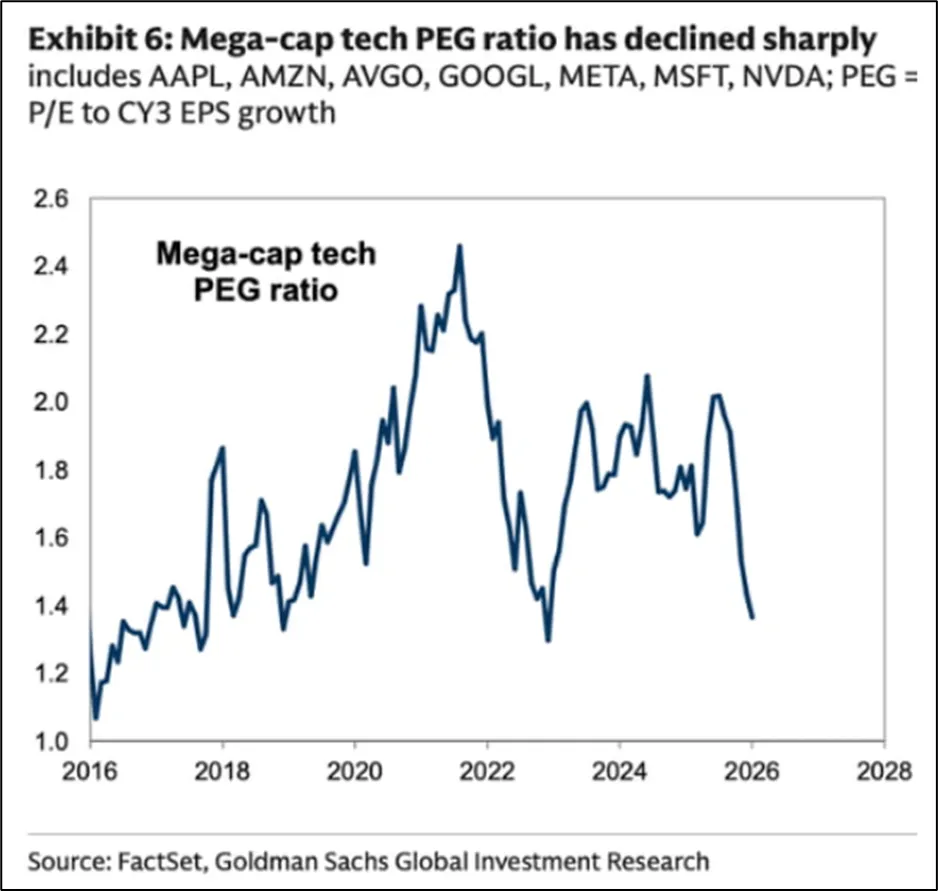
According to recent data from Goldman Sachs, the PEG ratio (Price/Earnings-to-Growth) for mega-cap tech stocks has declined sharply. This metric, which adjusts the P/E ratio for expected earnings growth, suggests that major tech companies are currently as undervalued as they were during the height of the Russia-Ukraine conflict fear. High EPS growth combined with compressed multiples indicates a “coiled spring” dynamic.
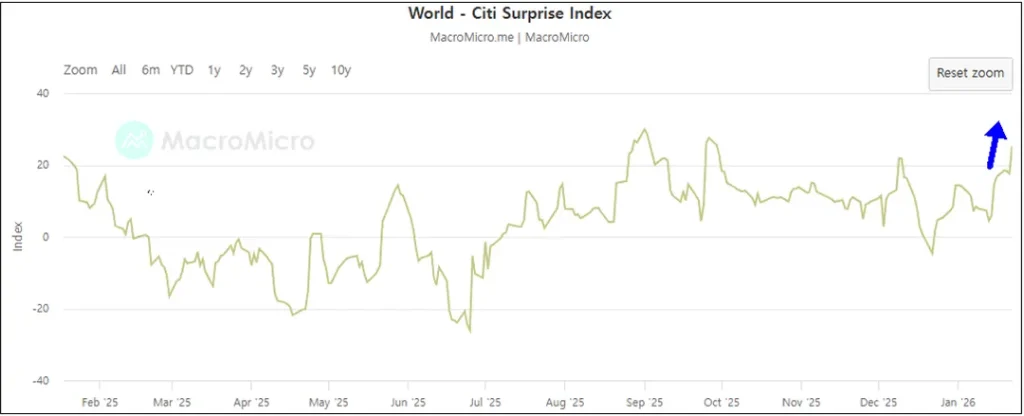
Furthermore, real economic data contradicts the recessionary narrative. The Dallas Fed Manufacturing Survey recently reported a surge in activity, with production jumping from -3.0 to +11.2 and new orders rising from -6.6 to +11.8. Coupled with strong durable goods orders and a rising Citi Economic Surprise Index, the data confirms that the U.S. economy is rebounding from its bottom.
The market is climbing a “wall of worry,” but the underlying structure is bullish. The convergence of rising liquidity, a resilient real economy, and a coordinated policy shift toward a weaker dollar creates a favorable environment for risk assets. As uncertainty is systematically removed—from Minnesota to Seoul—the Weak Dollar Bull Market is poised to drive U.S. equities, particularly undervalued growth sectors, to new highs.
[TMM’s Perspective] I strongly believe that the current market environment is skewed to the upside, despite the noise. The “game” is being managed: policymakers are ensuring that uncertainty does not break the market, maintaining a floor while liquidity refills the system. With the PEG ratios of mega-cap tech stocks screaming “undervalued” and a global consensus forming around currency stabilization, I see this as a prime opportunity to remain long on U.S. growth assets. The patterns of 2017 and early 2020 are repeating; do not bet against the coordinated liquidity cycle.