
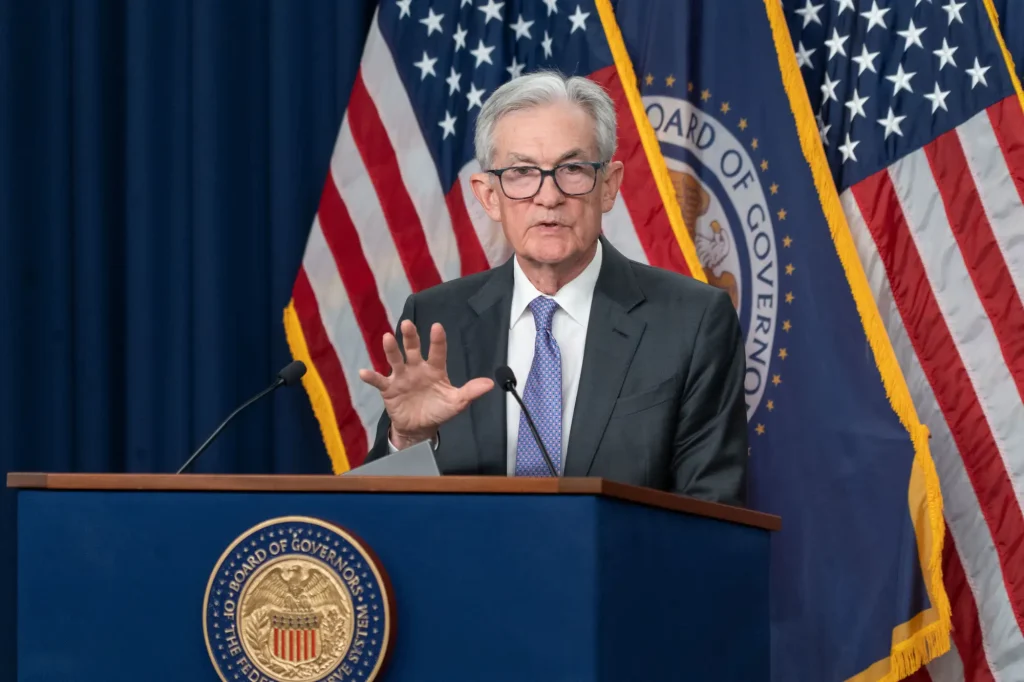
The Powell Fed Rate Hold 2026 marks a pivotal moment in US monetary policy as the Federal Reserve navigates a complex “data fog” characterized by trade-induced price pressures and a resilient domestic economy. Following the January FOMC meeting, Chair Jerome Powell confirmed the decision to maintain the federal funds rate at a target range of 3.50%−3.75%, signaling a strategic pause after three consecutive cuts late last year. This decision highlights the central bank’s commitment to balancing the dual mandate of maximum employment and price stability amidst shifting fiscal and trade landscapes.
The Internal Divide and the Powell Fed Rate Hold 2026
The January decision was notable not just for the hold itself, but for the rare lack of consensus within the Board. While the Powell Fed Rate Hold 2026 received broad support, the 10-2 vote revealed growing tension. Governors Christopher Waller and Stephen Miran (a recent Trump nominee) formally dissented, advocating for a 25-basis-point cut.
Despite this internal pressure for further easing, Powell emphasized that the current policy stance remains “appropriate” to support the Fed’s long-term objectives. The committee’s shift in language from “downside risks to employment” to “stabilizing labor market conditions” suggests that the Fed is no longer in a defensive posture against a hard landing, but is instead focused on managing the tailwinds of inflation.
| Indicator | Current Assessment (Jan 2026) |
| Fed Funds Rate | 3.50%−3.75% (Unchanged) |
| Economic Growth | Expanding at a “Solid Pace” |
| Labor Market | Job gains low; Unemployment stabilizing |
| Inflation Outlook | “Somewhat Elevated” due to Tariffs |
Navigating the “One-Off” Tariff Inflation Peak
A significant portion of the press conference was dedicated to the impact of trade policy. Powell characterized recent price increases as a direct consequence of tariffs, labeling them a “one-off” upward shift in the price level rather than a sustained inflationary trend.
The Fed’s internal projections suggest that tariff-driven inflation will likely peak by mid-2026. Powell noted that as these effects wash out of the year-over-year data, the “pathway toward the 2 percent objective” should become clearer. Importantly, he suggested that once this peak passes, it could open the door for renewed policy easing—provided that the broader economic resilience remains intact.
Institutional Independence and the Successor’s Path
Beyond monetary metrics, the Powell Fed Rate Hold 2026 discussion touched upon the existential challenges facing the institution. Powell took the unusual step of attending Supreme Court arguments for the “Cook Case” (Trump v. Cook), a legal battle testing the President’s power to remove Fed governors.
When asked for advice for his eventual successor, Powell’s response was characteristically blunt: “Stay out of elected politics.” He argued that the Fed’s democratic legitimacy is derived from its ability to prove its worth under congressional oversight, not by aligning with executive preferences. Regarding the nation’s fiscal health, he reiterated that while current debt is manageable, the current trajectory is unsustainable, particularly with large deficits occurring at full employment.
The Powell Fed Rate Hold 2026 serves as a temporary ceasefire in the battle against inflation. By resisting political pressure for immediate cuts and focusing on the transitory nature of tariff impacts, the Fed is betting on a “wait and see” strategy through the first half of the year. Investors should keep a close eye on the mid-2026 inflation peak; if the Fed’s “one-off” thesis holds true, the pivot to a more accommodative stance may be just around the corner.
[TMM’s Perspective] The dissent from both Waller and Miran is the “canary in the coal mine.” It suggests that the window for a unified Fed is closing, and the pressure to cut will become deafening if growth slows even slightly before the mid-2026 inflation peak. We believe the Fed is correctly identifying tariffs as a “level shift” rather than a “rate shift” in inflation, but the “data fog” Powell mentioned makes the risk of a policy error high. Strategy-wise, we are staying neutral on long-duration bonds until the tariff pass-through is fully realized in the Q2 data.