
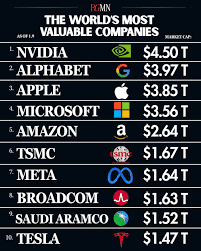
The Global Market Cap Rankings serve as an essential barometer for measuring the pulse of the world economy and the relative strength of corporate giants. By utilizing data aggregators like companiesmarketcap.com, investors can dissect market trends across various metrics—from valuation to revenue. Comparing the landscape of January 3, 2026, against the data from early 2025 reveals significant structural shifts in capital allocation and sector dominance, offering actionable insights for US stock market investors.
The 2026 Global Market Cap Rankings Shake-up
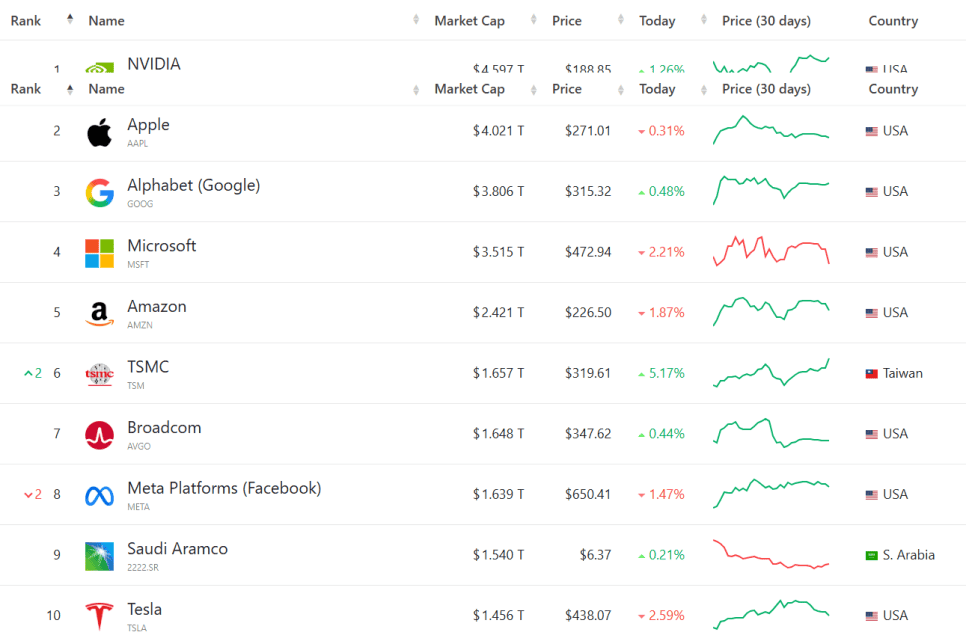
A year-over-year analysis of the top tier of the market reveals a continued consolidation of American economic power. As of January 2025, eight of the top ten global companies were US-based. Fast forward to January 3, 2026, and while the US dominance remains, the internal hierarchy has shifted dramatically.
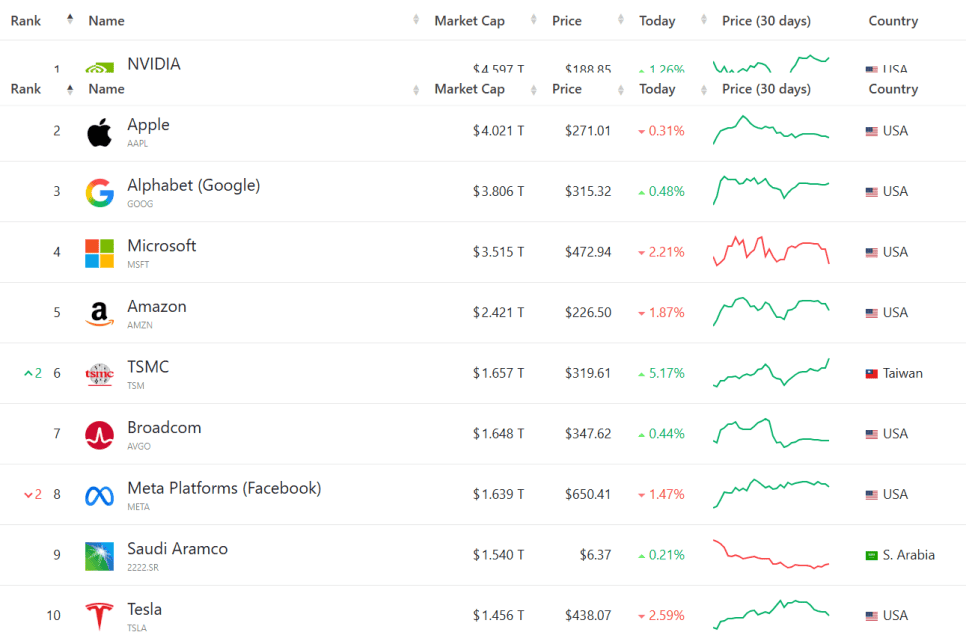
- Nvidia takes the Crown: Previously ranked 3rd, Nvidia has surged to the #1 spot, officially becoming the world’s most valuable company by market capitalization.
- New Entrants and Exits: Broadcom, previously outside the top tier, has entered the elite circle at #7. Conversely, Berkshire Hathaway fell from #8 to #11, dropping out of the top 10.
- International Movers: The non-US presence remains limited but volatile. Saudi Arabia’s Aramco slid from #6 to #9. Meanwhile, Taiwan’s TSMC demonstrated robust growth, climbing from #9 to #6, highlighting the continued semiconductor super-cycle.
Momentum analysis of these top 10 companies shows that 8 out of 10 experienced stock price appreciation over the last month. The notable underperformers in this short-term window were Microsoft and Aramco.
Emerging Contenders and the Samsung Surge
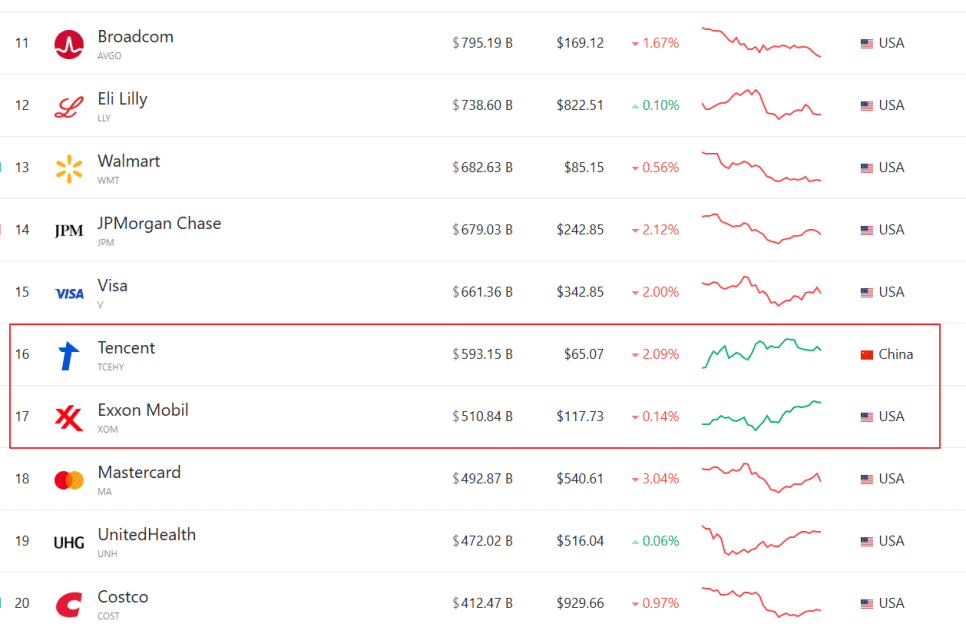
Moving beyond the top 10, the Global Market Cap Rankings for the 11th to 20th spots provide further insight into global sector rotation. In 2025, this tier included major players like Broadcom (now top 10), Eli Lilly, and Walmart, with China’s Tencent holding the #16 spot.
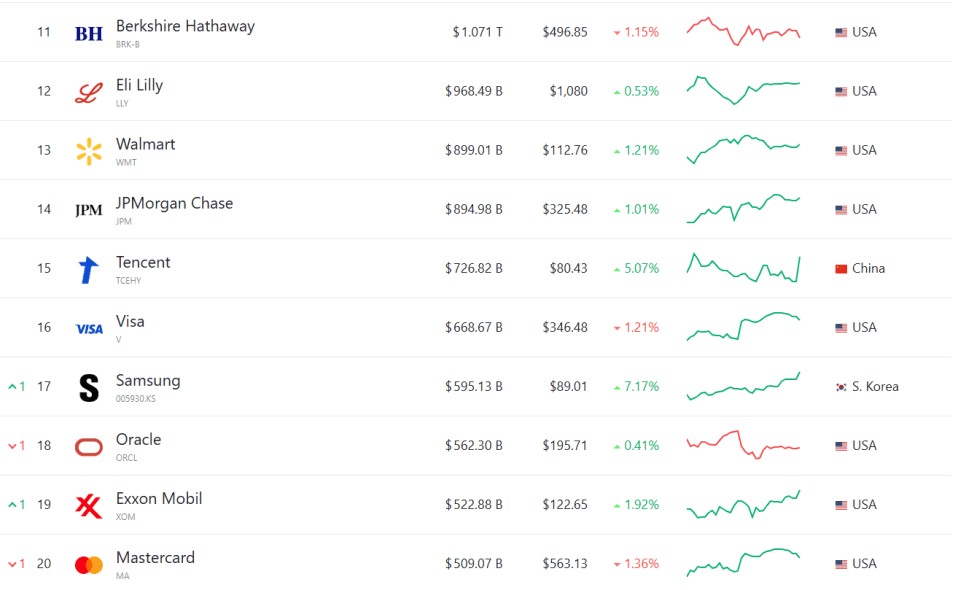
However, the most striking data point in 2026 comes from South Korea.
- Samsung Electronics’ Re-rating: In early 2025, Samsung Electronics languished at #38 globally. As of January 3, 2026, it has executed a massive leap to #17. This vertical movement suggests a significant repricing of its semiconductor or AI-related business segments.
Domestic Sector Rotation in Korea Drilling down into the specific country data for South Korea, the top 5 remains unchanged year-over-year (led by Samsung, SK Hynix, and LG Energy Solution). However, the lower half of the top 10 signals a rotation from internet/finance to industrials:
- Exits: Celltrion (#6), Naver (#8), and KB Financial (#9) have dropped out of the top rankings.
- Entries: They have been replaced by heavy industry players: HD Hyundai Heavy Industries (#6), SK Inc. (#7), and Doosan (#9).


Utilizing tools to track the Global Market Cap Rankings allows investors to spot trends that simple price charts might miss. From Nvidia’s ascent to the throne to Samsung’s rapid recovery, the hierarchy of capital is constantly evolving. Statistically, portfolios constructed solely of the global top 10 often yield higher returns than the broader S&P 500 index. This reinforces a vital lesson for 2026: complexity in analysis does not always guarantee superior results; sometimes, following the flow of global capital is the most effective strategy.
[TMM’s Perspective] I often emphasize that “hard work in investing does not equate to high returns.” The data discussed here supports a strategy of simplicity: focusing on the absolute winners. If a portfolio concentrated on the Top 10 Global Market Cap leaders historically beats the diversified S&P 500, it begs the question of why we overcomplicate our selection process. As we see heavy industries re-entering the Korean top ranks and semiconductors leading the US, sticking to the leaders of the current cycle—rather than bottom-fishing—remains my preferred approach for 2026.